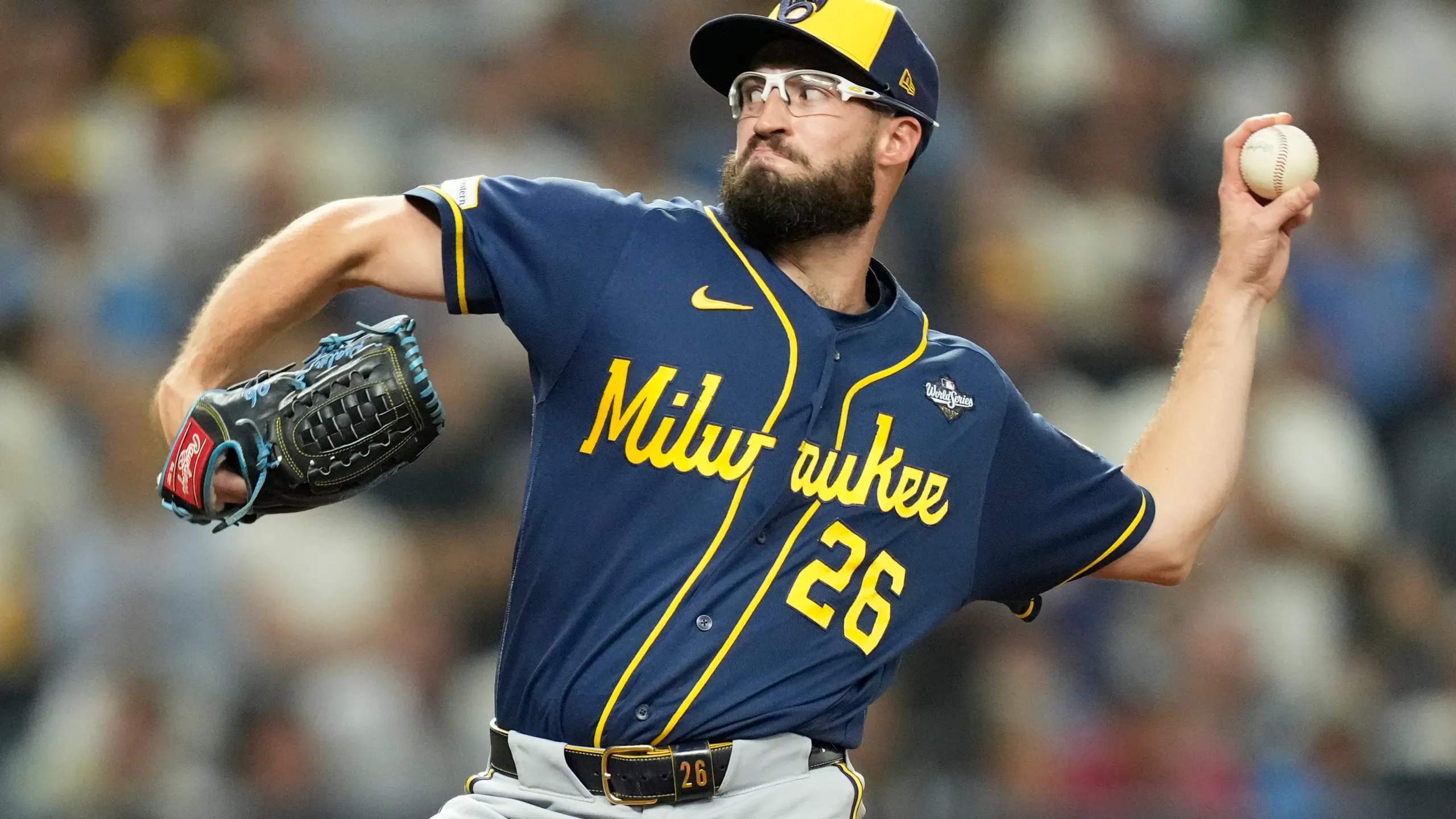
Milwaukee’s World Series Edge Is a Bullpen System, Not a Collection of Save Situations
Milwaukee reached Game 3 with a 2–0 World Series lead and a bullpen that treats the hardest outs as a sequence to solve, not a ninth-inning title to protect.
The Brewers arrived at Tropicana Field with a 2–0 World Series lead built by two one-run victories. The narrow margins make bullpen usage more revealing than a lopsided result would. Milwaukee relievers entered Game 3 with a 1.24 ERA through ten postseason games. Aaron Ashby had not allowed a run in 15 2/3 postseason innings and recorded a five-out save in Game 2, giving traditional closer Trevor Megill the night off. The Brewers became the first team in the save era to record eight saves in one postseason, while relievers had been credited with eight of their nine postseason wins.\n\nThose numbers do not simply describe good relief pitching. They describe a management system willing to distribute the final outs around matchups, rest and leverage. The word “closer” matters less when the game’s hardest sequence arrives in the seventh with the top of the order and runners threatening. Milwaukee’s advantage is the ability to treat each game as a chain of specific outs. Tampa Bay’s answer is to make that chain longer, force early traffic and prevent the Brewers from choosing every matchup on comfortable terms.
Eight saves reveal distributed responsibility
Save totals are usually discussed as an individual achievement. Milwaukee’s eight show that several pitchers have been trusted to complete different game shapes. A five-out save requires a different preparation and recovery plan from a clean ninth. The benefit is optionality. The cost is that roles must be communicated clearly enough that pitchers can prepare without relying on a fixed inning.
The repeatable mechanism is to deploy relievers according to leverage and matchup, ask selected arms for more than three outs and preserve alternative finishers for the following game. That sentence matters because it converts an attractive result or specification into a process that can be inspected. Readers should ask which part is controlled by the athlete or team, which part depends on the opponent or environment, and which part is simply variance. A serious conclusion survives that separation. A weak conclusion relies on the final score, the biggest product claim or one spectacular clip.
Execution also has an opportunity cost. Time, attention, recovery, money and roster roles are finite. Leaning further into this idea means doing less of something else. Coaches and consumers should name that trade before judging success. If the approach works only when every surrounding condition is favorable, it is not yet a dependable strategy; it is a useful option waiting for a broader test.
Ashby changed the following game too
By securing five outs in Game 2, Ashby closed the immediate contest and kept Megill unused. That preserved a premium arm for Game 3 while consuming more of Ashby’s availability. Good bullpen decisions always spend something. The manager’s job is to spend the arm whose present matchup advantage exceeds the future value being preserved elsewhere.
The best evidence will come from the uncomfortable version of the problem. A strong mechanism should remain visible when the first option is removed, the opponent changes the matchup, the connection drops or fatigue alters technique. In this case the key test is whether Milwaukee can preserve flexibility as the series compresses rest and the Rays see the same relievers repeatedly. That question is intentionally harder than asking whether the latest result looked impressive. It asks whether decision quality improved.
Film, sensor data and public statistics answer different parts of that question. None should be treated as complete. Numbers describe frequency and outcome; video explains spacing and sequence; participant feedback reveals usability and preparation. The most reliable evaluation triangulates all three and states clearly when one form of evidence is missing.
Tampa Bay must create messy innings early
A bullpen is easiest to sequence when the starter reaches the planned handoff and the bases are empty. The Rays need long plate appearances, runners and lineup pressure before Milwaukee’s preferred leverage arms can enter cleanly. Even an inning that does not score can matter if it adds pitches and forces a reliever to warm twice. The goal is to make the system react rather than execute a script.
Context should travel with every statistic. Score state, opponent quality, available personnel, venue, recent workload and sample size can turn the same number into a different story. That is especially important here because postseason relief dominance can reverse quickly under fatigue, inherited traffic or repeated exposure, especially when a starter exits before the plan expects. Acknowledging that limitation does not weaken the analysis. It prevents the useful claim from expanding beyond what the evidence can carry.
The practical response is to set a review window before emotions settle into certainty. Compare the next several games or sessions against the same mechanism, document adjustments and look for performance in ordinary conditions. A strategy becomes part of identity when it improves the floor of performance, not merely when it helps produce one memorable ceiling.
Repeated exposure gives hitters information
Short series favor the best arms, but they also let hitters collect visual and timing cues quickly. A slider that looked unfamiliar in Game 1 may be easier to track in Game 4. Milwaukee can counter with sequencing changes and by avoiding automatic matchups. Tampa Bay should judge at-bats by whether they reveal shape, release point and zone tendency even when the immediate result is an out.
Readers can follow this story without access to a private analytics department. Track starter length, first-batter efficiency, inherited runners, multi-inning workload, pitch counts, Tampa Bay’s pinch-hit options and how often Milwaukee protects Megill. Those indicators connect the visible outcome to the decisions underneath it. They can also expose when a promising story is being held up by finishing luck, unusually favorable competition or a measurement system that is too sensitive to noisy inputs.
Watch the response, not only the repetition. Opponents and users learn. The second encounter usually removes novelty and targets the most obvious dependency. If the subject can reach the same goal through a different alignment, control method or sequence, the original idea is becoming robust. If performance collapses once the first route closes, the early success still taught something—but it did not establish a durable edge.
One-run wins magnify defensive execution
Relievers inherit more than a score. Baserunning, fielding and positioning determine how many clean outs their pitches must earn. Tampa Bay’s unnecessary outs and fielding mistakes in the first two games, noted by MLB’s preview, reduced the pressure on Milwaukee. The Rays cannot beat a deep bullpen while donating the very resource it is built to collect: outs.
The human factor is not a soft add-on. Athletes must recognize cues under pressure, coaches must communicate the adjustment, and product users must understand what the device is asking them to do. A theoretically optimal plan that arrives too late or requires too much attention can be worse than a simpler plan executed consistently. The relevant design target is usable intelligence.
That is why the central decision remains whether Milwaukee can preserve flexibility as the series compresses rest and the Rays see the same relievers repeatedly. The answer should be based on behavior over time, not on a launch-day impression. Look for fewer avoidable decisions, clearer roles and a more reliable next action. Those changes are less dramatic than a headline number and more likely to create lasting value.
What would disprove the argument
The strongest counterargument is that postseason relief dominance can reverse quickly under fatigue, inherited traffic or repeated exposure, especially when a starter exits before the plan expects. That possibility deserves an explicit place in the evaluation. Too much sports analysis declares a trend and waits for confirming evidence; too much product coverage repeats a specification and calls it a benefit. Gamehai uses the opposite discipline: state the alternative, identify what it would look like and revise the conclusion when the observed behavior fits it better.
Disproof may arrive gradually. A strategy can remain sound while execution fails, and a product can be well designed for a narrower audience than its campaign suggests. We will separate those cases. The question is not whether every result turns positive. It is whether the proposed mechanism continues to improve the decisions available under realistic conditions.
The next evidence that matters
The most useful follow-up is not another headline. It is a consistent record of starter length, first-batter efficiency, inherited runners, multi-inning workload, pitch counts, Tampa Bay’s pinch-hit options and how often Milwaukee protects Megill. Those observations should be collected across several relevant samples, with the surrounding conditions preserved. Changes in opponent, health, setup or role should be noted instead of treated as noise to be discarded.
Pay special attention to adjustment speed. Elite competition and mature technology ecosystems do not remain static. Rivals change coverage and protection; athletes change pacing; software changes its model; users adapt their habits. The durable advantage belongs to the system that notices the new problem and reaches a workable second answer without abandoning its core purpose.
How Gamehai reached this view
Gamehai reviewed the first-party reporting and product information linked below, separated reported facts from editorial inference and tested the central argument against a plausible alternative. No league, team, player, coach or manufacturer reviewed this article. Product pieces are specification-based editorial analyses unless hands-on testing is explicitly stated; they should not be read as laboratory validation, medical advice or a guarantee of performance.
Our standard is usefulness rather than certainty. We explain the mechanism, the cost, the counterargument and the evidence readers can watch next. When an official source corrects a fact or later evidence changes the conclusion, the article should be updated with a visible correction or clarification.
Gamehai verdict
The current evidence supports a focused conclusion: deploy relievers according to leverage and matchup, ask selected arms for more than three outs and preserve alternative finishers for the following game. The promise is credible because it connects a visible result with a decision process. The limit is equally important: postseason relief dominance can reverse quickly under fatigue, inherited traffic or repeated exposure, especially when a starter exits before the plan expects.
For now, the practical test is whether Milwaukee can preserve flexibility as the series compresses rest and the Rays see the same relievers repeatedly. Readers should return to that question after the next meaningful sample. If the process remains clear when the easy conditions disappear, this development will matter beyond the ten-day news cycle. If it does not, the first result was still informative—but smaller than the headline.