Taylen Green and the Browns’ Multi-Quarterback Plan: Development Without a False Deadline
Cleveland’s quarterback competition should be a sequence of defined tests, not a daily referendum built from one spectacular throw.
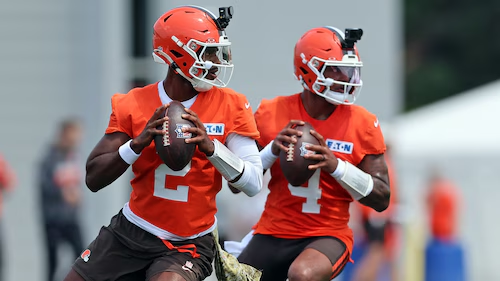
Cleveland selected Arkansas quarterback Taylen Green with the 182nd pick, adding a mobile, strong-armed prospect to a room already defined by uncertainty. The easy story is competition. The more useful story is experimental design: how the Browns can give several quarterbacks enough comparable work to learn something without flattening their different strengths.\n\nGreen’s movement and vertical capacity can make a practice period look different from a rhythm passer’s. That is not evidence that one style is automatically better. Cleveland needs shared situations—third down, pressure identification, red zone and two-minute operation—combined with a smaller set of calls tailored to each player. Otherwise the evaluation rewards whoever best fits the test rather than whoever can best protect the offense.
Comparable reps require comparable problems
Completion percentage across different concepts is weak evidence. The staff should compare decisions against the same coverage families, pressure looks and down-and-distance requirements, then grade whether the quarterback preserved the intended answer. The film test is whether the offense can reach the answer without declaring it before the snap. Personnel grouping, motion and formation should create uncertainty, while protection gives the quarterback a defined escape when the preferred matchup disappears. That is more revealing than one explosive play because it shows whether the idea can survive a coordinator who has studied the tendency.
Mobility needs an NFL purpose
Green’s athletic ability matters most when it converts a broken edge into an efficient result, changes a run count or buys time without abandoning structure. Escapes that create a highlight but miss an earlier completion should not receive the same grade. Efficiency must be separated by situation. Early-down success, pressure response, third-and-medium conversion and red-zone execution describe different problems. A sound evaluation of Taylen Green Browns quarterback development should therefore connect the rate statistic to the call, coverage and score state that produced it, not treat every snap as interchangeable evidence.
The deep ball begins with protection
A strong arm can widen the playbook only if the quarterback understands when the line can hold and where the immediate outlet lives. Cleveland should attach a fast answer to every developmental shot call. Roster strategy matters because every specialist consumes a game-day place and practice time. The strongest plan creates overlap: a player who changes the geometry of one package should also execute the ordinary assignments that keep the full menu available. Otherwise the defense can identify the package before the ball is snapped.
Preseason statistics will be noisy
Line combinations, receiver precision and play-calling goals vary by quarter. Decision timing, sack responsibility and operation before the snap provide a more stable basis than yards against a late-game defense. Opponents will answer with disguise, leverage and selective pressure. The useful question is whether the offense still owns a low-cost completion or efficient run when the defense removes the headline option. Sustainable strategy is rarely the first move; it is the quality of the second answer after the first move appears on film.
The roster cannot carry unlimited experiments
Practice repetitions and game-day places are finite. The competition should establish milestones so the room gradually narrows while the remaining players still receive a fair test. Health and workload belong inside the tactical discussion. A concept that depends on long-developing routes, repeated collisions or constant movement may be effective yet too expensive to feature every week. Coaches have to balance the expected value of the play with the physical cost of maintaining it through January.
A patient decision can still be decisive
Patience means collecting the right evidence, not avoiding a choice. Once processing, protection command and situational performance separate, the Browns should define roles clearly enough for the offense to build continuity. The forecast should remain conditional. If the line communicates, the quarterback reaches the correct outlet and the skill group preserves spacing, the ceiling rises. If one of those links breaks, the same design can produce negative plays. That chain is what readers should track when the regular-season evidence arrives.
The strongest counterargument
Quarterback rooms can become so focused on fairness that the likely starter receives too few repetitions with the first unit. Cleveland cannot allow the evaluation process to damage preparation. The answer is a planned funnel, not an indefinitely equal split.
What to watch next
The next useful evidence will come from deployment, not one splash play. Track personnel groupings, pre-snap motion, route depth and the quarterback’s first answer against pressure. If the offense can present the same formation and reach several different concepts, defenses will have fewer clean tendencies to attack. Third-down usage matters too: a player or idea that survives only in carefully scripted early-down situations is a package, not yet a foundation.
Also watch how opponents answer after the first two weeks of tape. Coordinators may rotate coverage earlier, press with safety help or force the offense to win through its least comfortable matchup. The strongest strategy is the one that still creates an efficient outlet after that adjustment. Gamehai will revisit the conclusion when snap counts, pressure rates, explosive-play frequency and situational usage provide a larger sample.
A useful re-evaluation should preserve the conditions around the evidence: opponent quality, score state, available personnel and the choices that created the result. Without that context, a promising trend can become a conclusion too quickly. We will compare the next sample with the mechanism described above, not merely with the final score or headline number. That approach gives readers a clear test for whether the original argument is strengthening, weakening or being replaced by a better explanation.
How Gamehai reached this view
Gamehai reviewed the primary reporting and official material linked below, then evaluated the subject through role, spacing, decision-making, roster construction and repeatable process. We distinguish confirmed facts from our analysis, avoid treating a short sample as a permanent trend and update material errors when better information becomes available. This is independent editorial analysis; no team, league, product maker or commercial partner reviewed or approved the conclusion.
Readers should treat tactical projections as informed scenarios rather than guarantees. Coaching choices, health, opponent adjustments and new regulatory decisions can change the outcome. Our standard is to explain what evidence supports the current view, what could invalidate it and what to watch next.
Editorial bottom line
Green gives Cleveland a valuable developmental path if the Browns measure the quarterback job rather than the most visible trait. The correct deadline is the point when comparable evidence becomes clear—not the day public curiosity peaks.
Reading the evidence without overreacting
The central argument in Taylen Green and the Browns’ Multi-Quarterback Plan: Development Without a False Deadline is not a prediction built from one result. It is a working explanation that must survive changes in opponent, personnel and game state. The cleanest test is to identify the decision that created the advantage, then ask whether the same decision remains available when the obvious counter arrives. A highlight can show what is possible; a sequence of ordinary possessions, snaps, shifts or plate appearances shows what is sustainable. That distinction matters because public discussion often starts with the outcome and invents the mechanism afterward. This analysis takes the opposite route: establish the mechanism, identify the conditions around it and allow the next sample to confirm or weaken the view.
For readers tracking Taylen Green Browns quarterback development, context should be recorded alongside every number. Opponent quality, score margin, rest, travel, injuries, lineup or personnel combinations and the phase of the season can all change what a statistic means. A rate produced in low-leverage minutes is not automatically transferable to a decisive situation, just as a poor result against an elite opponent does not automatically disprove sound process. The expert habit is comparison: measure the same decision across similar situations, then use film or play-level detail to explain why the result moved. That creates a conclusion with an audit trail rather than an opinion protected by vague language.
The opponent gets a vote
Strategy is interactive. Once a useful tendency appears, opponents will attack its timing, spacing, matchups and weakest supporting role. The next stage of this story therefore belongs to the counter. Does the team have a second action when the first is denied? Can a player preserve value when forced away from the preferred location? Can the staff change the presentation without abandoning the principle that made the original plan work? Those questions separate a short-term surprise from an identity. They also prevent analysis from treating the other side as a passive backdrop. Serious evaluation should credit the adjustment that changes the contest, not merely blame the player whose final action becomes visible.
The response may be subtle. It can be a different release against pressure, a quicker weak-side decision, a changed pitch sequence, a safer exit route or a more conservative substitution. These choices rarely dominate a box score, but they determine whether a team keeps access to its best players and preferred spaces. When the next games arrive, readers should look for those quiet changes before deciding that the original argument has succeeded or failed. A sophisticated opponent can make a good idea look temporarily ineffective; a sophisticated response restores the advantage at a lower cost.
Personnel, workload and the hidden price of the plan
Every tactical choice carries a roster cost. A specialist may improve one situation while narrowing the rest of the playbook. A star can solve a difficult possession while accumulating a workload that reduces later effectiveness. A coach can chase the best immediate matchup while denying a developing player the repetitions needed for the next month. The most complete reading of Taylen Green Browns quarterback development therefore connects performance with resource allocation. It asks who absorbs the difficult assignment, who supplies the support away from the ball or puck, which bench or depth role becomes exposed and whether the plan can be repeated through normal fatigue.
This is especially important over a four-month editorial window. April evidence can describe a possibility; August evidence may describe a team that has changed through health, transactions, practice and opponent learning. Gamehai dates each article to the moment its evidence was available and keeps the conclusion conditional. Later developments should be read as an update to the record, not silently projected backward. That approach protects the difference between analysis written in real time and hindsight presented as certainty.
A practical checklist for the next game
First, identify the opening plan and the specific problem it is designed to solve. Second, note the opponent response and how quickly it appears. Third, watch which supporting player or unit must make the next decision. Fourth, separate execution failure from structural failure: a missed shot, dropped pass, lost edge or misplaced pitch does not by itself invalidate a sound choice. Fifth, record whether the same pattern appears in a different score state or matchup. This checklist turns NFL coverage into something readers can test for themselves rather than a conclusion they are asked to accept on authority.
The final standard is explanatory value. If the framework helps a reader anticipate the next adjustment and understand why a coach, player or front office chose it, the analysis is doing useful work even when the outcome remains uncertain. If it explains only what already happened, it needs revision. Taylen Green and the Browns’ Multi-Quarterback Plan: Development Without a False Deadline should therefore be treated as a clear, sourced position at a defined point in the season—strong enough to guide attention, open enough to change when better evidence arrives.