Texas Stayed No. 1 by Winning Without Margin
Ten sacks gave Texas control of the game’s most valuable moments. The narrow score showed why that pressure cannot become an excuse for offensive stagnation.
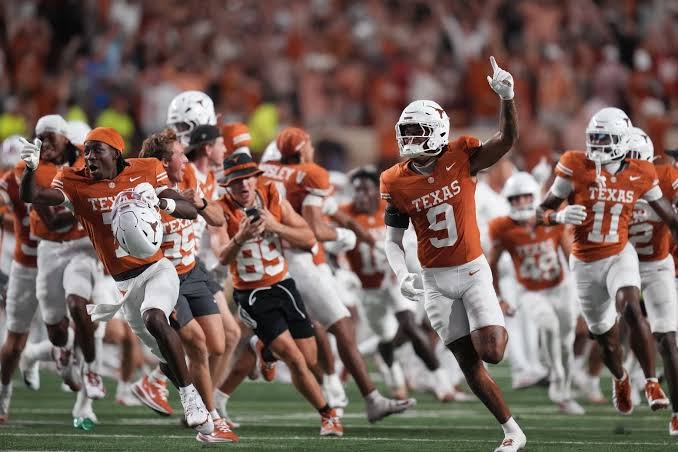
Texas beat Tennessee 20–17 to move to 4–0 and secure its first conference victory of the season. The Longhorns held the Volunteers to 221 yards and produced ten sacks, the second-highest total in school history. Colin Simmons recorded five, tying the Texas single-game record and becoming the first FBS player since 2006 to reach five sacks against a ranked opponent.
Those numbers are dominant. The final margin was not. That combination is the correct frame for the nation’s No. 1 team: Texas has a defensive mechanism capable of controlling a ranked opponent, while its offense remains close enough to the edge that one coverage bust or special-teams mistake could reverse the result.
The pass rush worked as a structure, not a stunt show
Simmons’ production deserves individual credit, but five sacks rarely occur in isolation. Texas pressured Tennessee on 21 of 50 dropbacks, and the Volunteers completed two of eight passes for seven yards under pressure. Those results indicate that coverage and rush timing were connected. The quarterback could not simply climb away from Simmons into an open middle.
The Longhorns’ front made Tennessee’s protection declare itself, then attacked the weak point. Interior push reduced escape space while edge pressure forced the quarterback to speed his clock. When a defense creates that kind of compression, the sack is the visible end of a play that several defenders helped shape.
Simmons changed the protection math
Once an edge rusher wins repeatedly, the offense must send help, slide the line or change the release timing. Each response has a cost. A tight end staying in protection removes a receiver. A back checking the edge delays the outlet. A slide can create a one-on-one matchup elsewhere. Simmons’ five sacks were valuable beyond the lost yards because they kept charging Tennessee for the same problem.
Future opponents will not wait for him to take over. They will chip early, move the pocket and throw screens behind his upfield charge. Texas must prepare the counter without reducing the aggression that makes him special. The next step is turning the attention Simmons attracts into pressure for teammates.
The secondary deserves credit for the quarterback’s hesitation
A pass rush is often measured by the moment it reaches the quarterback. Coverage controls how long the journey is allowed to take. Tennessee’s poor production under pressure suggests Texas took away the immediate escape throws often used to punish a blitz or aggressive front.
That does not mean every coverage was perfect. It means the first read and the rush arrived on a compatible timeline. Against opponents with faster perimeter answers, Texas may need to disguise leverage and tackle the short completion rather than chase the same sack total. A defense that can win with pressure and with disciplined rallying is harder to scheme than one addicted to negative plays.
Arch Manning’s efficiency kept the floor stable
Manning completed 14 of 19 passes for 201 yards. The stat line did not need to compete with the defense for drama. Its value was that Texas avoided asking the quarterback to rescue the game repeatedly. Efficient completions preserved field position and allowed the Longhorns to keep using the defensive advantage.
The offense still needs more ways to create separation. A championship team cannot assume ten sacks when it faces an opponent built to release the ball quickly. Manning’s next development point is not simply more volume. It is control of the middle downs: turning second-and-medium into first downs before the offense reaches an obvious passing situation.
Raleek Brown gave Texas a necessary change of pace
Brown produced 67 rushing yards and two touchdowns, providing points in a game where sustained offensive rhythm was limited. His contribution mattered because Tennessee could not devote every answer to the quarterback. A runner who presses the correct gap and finishes scoring opportunities allows Texas to play with a broader call sheet.
The Longhorns should avoid turning his two scores into an argument for indiscriminate volume. The better question is which run concepts created clean reads and whether those same formations can support play action. Brown’s value expands when the defense cannot identify from personnel whether he is the primary threat or the decoy.
No. 1 status raises the burden of self-scouting
Texas has 16 wins over ranked opponents since 2023, evidence that the program is not living on one September result. The top ranking still changes how the Tennessee tape will be used. Every opponent will study how the Volunteers created the possessions that kept the game close, not only how Texas created ten sacks.
The Longhorns should perform the same hostile review. Which offensive concepts stalled after the first read? Where did Tennessee create favorable down-and-distance? Which pressure calls would have been punished by a more accurate quick game? The ranking is safest when it sharpens the questions rather than reassuring the room.
The defense cannot become the offense’s alibi
Elite defenses sometimes create an unhealthy bargain: the offense becomes conservative because it expects field position and another stop. That can win many games and fail in the one matchup where the opponent blocks the front or creates an explosive play. Texas should use its defensive strength to expand offensive options, not to avoid developing them.
There will be moments to protect the ball and trust the defense. There should also be early-down shots, tempo changes and route combinations that prepare Texas for a higher-scoring game. The goal is not to make Manning chase statistics. It is to prevent the team from having only one script when the pass rush is ordinary.
What to watch before the next major test
Watch how opponents allocate protection to Simmons and whether Texas can create pressure through the opposite gap without bringing extra defenders. Track first-down efficiency on offense and the number of possessions that reach third-and-long. Note whether Brown’s role is connected to play-action looks or isolated as a short-yardage solution.
Texas remained No. 1 because its defense could win a game with almost no margin. The next level is building an offense that makes those defensive performances decisive rather than necessary. Ten sacks should be a championship weapon, not a weekly survival requirement.
How Gamehai reached this view
Gamehai reviewed the official league, team and governing-body material listed below, then separated reported facts from editorial interpretation. The analysis focuses on repeatable mechanisms—deployment, sequencing, workload, matchup and decision quality—rather than treating one result as permanent proof. No team, league, athlete, sponsor or commercial partner reviewed or approved this article.
Current-affairs analysis can change as injury information, lineups and official decisions develop. We preserve that uncertainty by identifying what evidence would strengthen or weaken the argument and by correcting material errors under our published corrections policy.