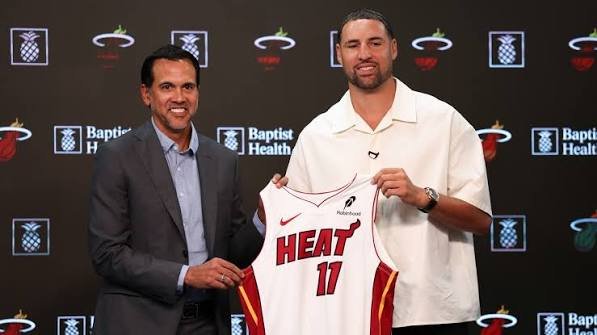
Klay Thompson in Miami: The Spacing Blueprint That Could Unlock the Heat
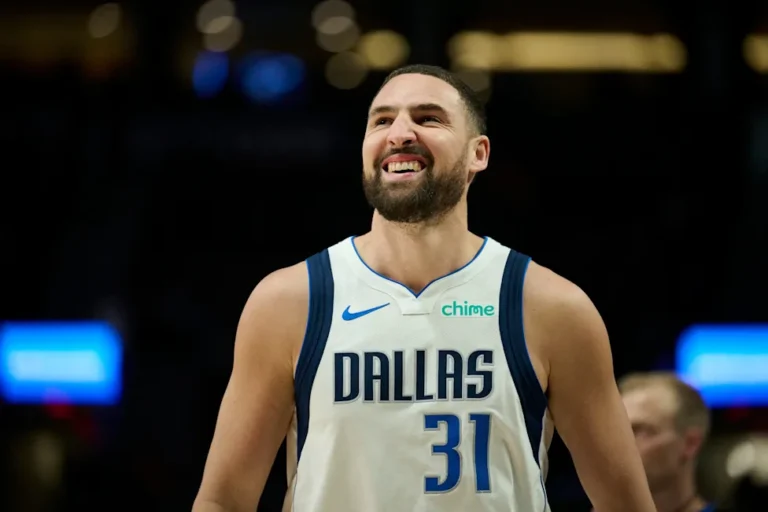
Klay Thompson’s value in Miami will be measured less by shot volume than by how far his movement pulls the defense away from everyone else.
Miami has spent years trying to manufacture space with movement, screening and decision-making because it has not always possessed overwhelming pull as a shooting team. Klay Thompson changes the starting point. Even late in his career, defenders do not casually help off him. They top-lock his cuts, chase him over screens and communicate early when he changes sides of the floor. That attention can create the half-step Miami’s drivers and handoff operators have often had to build through effort.\n\nThe temptation will be to treat Thompson as a stationary solution: put him in the corner and let gravity do the work. That would help, but it would leave much of his value unused. The more interesting blueprint turns his movement into a chain reaction. Miami can make the defense choose between switching smaller players onto screeners, conceding a brief shooting window, or sending two defenders toward a route that never touches the ball.
Movement shooting can organize the possession
A Thompson pindown is not only a play for Thompson. It can be the opening movement that clears the lane for a second action. Miami can run him from the corner toward the wing while a big screens, then flow directly into a handoff or empty-side pick-and-roll on the opposite half. If two defenders trail the shooter, the second action begins against a tilted floor. If the defense switches, the screener can seal a smaller player. The important design principle is continuity: the shot threat should begin the possession and improve the next decision rather than end the possession with a forced attempt.
Empty-side actions create the cleanest stress
Miami can place Thompson on the weak side with only one teammate involved in the primary action. When he lifts from the corner as a ball handler turns the corner, his defender must choose between tagging the roller and staying connected. That is a difficult assignment because Thompson needs very little time to set his feet. The Heat can also invert the relationship and use him as a screener. A guard screening for a larger creator encourages a switch, and a quick slip toward the arc can punish any defender who turns his head. These details create advantage without asking Thompson to dominate the ball.
The shot diet needs boundaries
Gravity is valuable only if the offense does not become predictable in pursuit of it. Miami should distinguish between early, balanced threes created by movement and late, leaning attempts taken because the play was called for a famous shooter. Thompson can still punish a defense on difficult shots, but those possessions should be the exception. The Heat will know the structure is working when his presence increases paint touches, free throws and corner attempts for teammates—even during nights when he makes only a few shots.
Defense will decide the closing lineups
The offensive fit is easy to imagine; the postseason question is who Thompson can guard in the final six minutes. Miami can protect him by placing him on lower-usage wings and using early switches to avoid repeated point-of-attack chases. Zone possessions can also reduce the number of long recovery sprints. But opponents will search for him if they believe the matchup yields an advantage. His positioning, communication and defensive rebounding must be reliable enough that the spacing benefit remains on the floor. The best lineup may not be the five biggest names; it will be the five whose coverage responsibilities connect.
The strongest counterargument
Age and workload are the obvious constraints. Constant off-ball movement is physically expensive, and Miami should not expect the same volume every night. There is also a risk that the offense becomes too dependent on a shooter who no longer bends every matchup equally. The solution is to use Thompson’s gravity as a versatile ingredient, not a single-point system.
What to watch next
The best checkpoint is not a single scoring average. Watch the shape of possessions: where the first advantage begins, how often the defense sends a second defender and whether the weak-side player receives the ball with time to act. Lineup data becomes more useful when paired with film showing who bends the coverage and who merely benefits from it. Late-clock possessions will reveal whether the proposed fit creates another dependable solution or simply moves the same problem to a different spot.
Opponents will test the idea by switching, shrinking the floor and making the weakest shooter or defender decide the possession. The coaching response should be visible in screening angles, off-ball movement and substitution patterns. Gamehai will judge the strategy across several matchup types rather than a short winning streak, with particular attention to half-court efficiency, turnover pressure, shot quality and the minutes when the primary star rests.
A useful re-evaluation should preserve the conditions around the evidence: opponent quality, score state, available personnel and the choices that created the result. Without that context, a promising trend can become a conclusion too quickly. We will compare the next sample with the mechanism described above, not merely with the final score or headline number. That approach gives readers a clear test for whether the original argument is strengthening, weakening or being replaced by a better explanation.
How Gamehai reached this view
Gamehai reviewed the primary reporting and official material linked below, then evaluated the subject through role, spacing, decision-making, roster construction and repeatable process. We distinguish confirmed facts from our analysis, avoid treating a short sample as a permanent trend and update material errors when better information becomes available. This is independent editorial analysis; no team, league, product maker or commercial partner reviewed or approved the conclusion.
Readers should treat tactical projections as informed scenarios rather than guarantees. Coaching choices, health, opponent adjustments and new regulatory decisions can change the outcome. Our standard is to explain what evidence supports the current view, what could invalidate it and what to watch next.
Editorial bottom line
Thompson can unlock Miami if the Heat use him to move defenders before the decisive action, not simply to wait for a kick-out. The blueprint is movement, empty-side spacing and selective screening, supported by a defensive plan that keeps him available late. His box score will matter. The shape of the floor will reveal even more.